Inside RAG: How Retrieval-Augmented Generation Works
RAG is the reason an AI assistant can answer a question about something it never memorized, and then tell you where the answer came from. It retrieves passages from external sources, passes them to the model, and asks it to write based on that evidence. For anyone doing GEO, this is the machinery that determines whether your content is evidence or invisible. This article explains what RAG is, why it matters, how it works from a GEO perspective, its benefits and limitations, and how to write content that RAG systems can retrieve and cite.
TL;DR
- RAG stands for retrieval-augmented generation. The model looks things up before it answers instead of relying only on what it memorized during training.
- The pipeline is four moves: retrieve relevant passages, augment the prompt with them, generate an answer grounded in that text, and cite the sources.
- It exists to fix two problems: hallucinations and the knowledge cutoff. Grounding answers in retrieved text makes them checkable.
- Content is retrieved as chunks, not pages. Documents get split into smaller units, embedded, and matched by similarity, so a single strong section can be pulled without the rest of the page.
- Reranking is the second gate. Systems often retrieve many candidates, then rerank down to the few best before generation.
- For GEO, RAG is the whole game. If your chunk is not retrieved, it can’t be cited, no matter how good the page is.
- You win by writing self-contained, factual, clearly structured passages that survive being pulled out of context.
What Is Retrieval-Augmented Generation (RAG)?
Retrieval-augmented generation is a technique that lets a language model look things up in an external knowledge source before it answers, rather than relying only on what it learned during training.
When a question arrives, the system first retrieves the most relevant passages, then augments the prompt by placing those passages alongside the question, and finally generates an answer grounded in that retrieved text.
The simplest way to hold it in your head: RAG turns a closed-book exam into an open-book one. The model is still the reader, but now it has the right page in front of it.
Underneath, a standard pipeline runs in three stages. Documents are preprocessed and split into smaller units called chunks. Those chunks are turned into embeddings and stored in an index. At query time, the system retrieves the closest chunks by similarity, and the model writes from them, guided by external information instead of its own memory.
Worth separating from two things it is often confused with:
- Not fine-tuning - Fine-tuning shapes how a model behaves. RAG changes what it knows at the moment of answering.
- Not plain search - Search returns links. RAG returns a written answer built from the retrieved text, with citations pointing back.
Why Is RAG Important?
RAG matters because it fixes the two failures that make raw language models risky in production: making things up and not knowing anything recent. Because the model sees explicit evidence, its answers tend to be more grounded and less likely to hallucinate.
It has also become the default architecture behind AI search. Most AI engines use retrieval-augmented generation to pull specific passages from web pages and feed them to the model as context, so RAG is not a niche enterprise pattern. It’s the layer standing between your content and every AI answer your audience reads.
Why this reaches beyond engineering:
- Freshness without retraining - The model can answer about last week's change because the retrieval step reads current sources.
- Verifiability - Because the answer is built from named passages, it can carry citations that a reader can check.
- Reduced hallucination, not eliminated - Grounding cuts fabrication sharply, but it doesn’t remove it entirely.
- A new distribution channel - Being retrieved and cited puts your brand in front of people who may never click through to your site.
How Does RAG Function In Terms Of GEO?
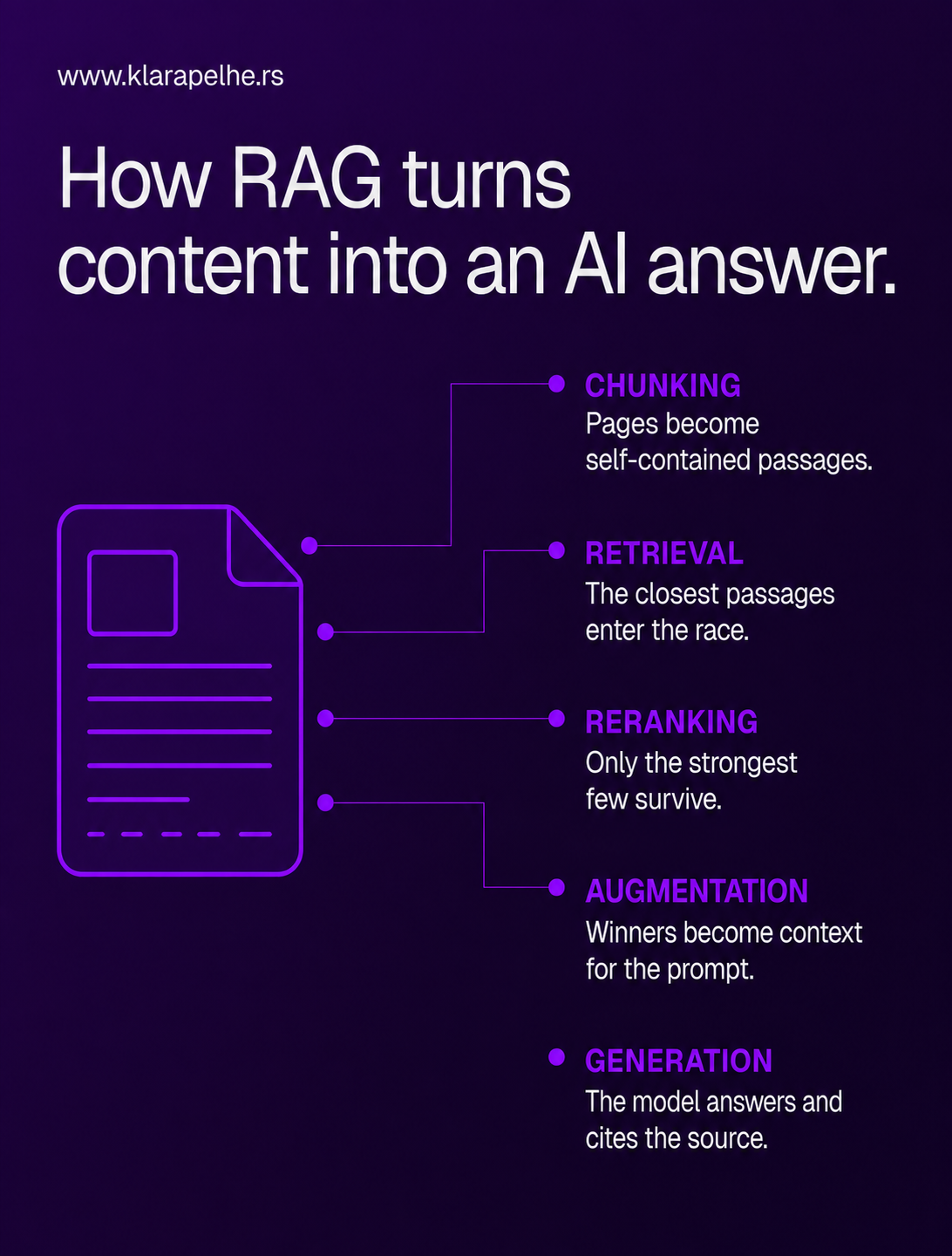
From a GEO point of view, RAG is a series of gates, and your content has to pass each one to end up cited. The engine doesn’t read your page the way a person does. It reads a chunk of it, scores that chunk against the prompt, and decides whether it earns a place in the context window.
Your content enters at the far left as a chunk, not as a page. Here is what each gate demands of it.
Stage | What the engine does | What it means for your content |
Chunking | Splits documents into smaller chunks before indexing, to fit context limits and improve precision | Your page competes as sections, not as a whole. Each section must make sense alone. |
Retrieval | Embeds the chunks and the query, then pulls the nearest matches by similarity | Semantic closeness decides entry. Meaning matters more than exact keywords. |
Reranking | Reorders candidates on fine-grained semantic relevance, keeping the strongest few | Being retrieved is not enough. Your passage has to be the most useful of the ones pulled. |
Augmentation | Only the passages that make the final cut can shape the answer. | |
Generation | Write the answer from that context and attribute the sources | Clear, factual, attributable passages are the ones that get named. |
Two details are worth internalizing. First, engines often break the question into smaller sub-queries and search for each one separately, so a question you never targeted directly can still retrieve your page. Second, ingestion pipelines prioritize structured, clearly attributed, and factually grounded text, so formatting is not merely cosmetic here. It’s part of whether you get pulled at all.
Biggest Benefits And Challenges Of RAG
RAG gives you a path into AI answers that doesn’t depend on ranking first on Google, but it also introduces failure points that traditional SEO never had. Both sides are worth knowing, because the challenges are where most content quietly loses.
The benefits:
- Access without top rankings - Page one and AI citations are drifting apart. Research from Brandlight suggests the overlap between top Google links and AI-cited sources has dropped from 70% to below 20%, so retrieval is a separate opportunity.
- Passage-level entry - One excellent section can be retrieved even when the rest of the page is unremarkable.
- Citation as authority - Getting named as a source builds credibility with readers who never visit your site.
- Evidence beats persuasion - Because the model needs facts it can attribute, specific, verifiable content has an edge over marketing prose.
The challenges:
- Chunking can break your meaning - If a passage depends on the paragraph above it, splitting the page can strip out the context that made it useful.
- The reranker is unforgiving - A system might retrieve twenty candidates and rerank down to the best four, so a mediocre passage that gets retrieved still loses.
- Garbage in, garbage out - RAG is only ever as good as the documents you feed it, which cuts both ways: thin or vague content won’t carry an answer.
- Grounding is not a guarantee - RAG reduces hallucination but doesn’t eliminate it, so your content can still be summarized loosely or paraphrased away from your point.
Best Practices For Creating Content Suitable For RAG
To write for RAG, build every section as a passage that still works when it’s torn out of the page and dropped into a prompt with no surrounding context. That single constraint drives most of the practical advice below.
What to do:
- Make each section self-contained - AI engines parse content by sections, not by page, so each one must be understandable and citable on its own.
- Cover one concept per section - Don’t mix definitions with how-to instructions in the same section. Give each idea its own structural home.
- Lead with the answer - Put the direct response in the first sentence or two, not after a long windup.
- Keep paragraphs short - Two to three sentences maximum. Long blocks are harder to chunk cleanly.
- Surface facts rather than burying them - Don’t bury statistics inside long narrative paragraphs. Give every important fact its own structural context.
- Cite your own sources - Articles with inline citations to research studies, government data, and industry reports score higher in the RAG retrieval process, because engines favor text that is clearly attributed.
- Use descriptive headings - Headings that state the question or the claim give the chunker clean boundaries and give the model a reason to trust the block.
- Add structure the machine can read - Tables, comparison rows, and step lists are easy to parse and easy to extract.
- Name entities plainly - Products, people, and concepts stated by name give the engine something concrete to attach the citation to.